
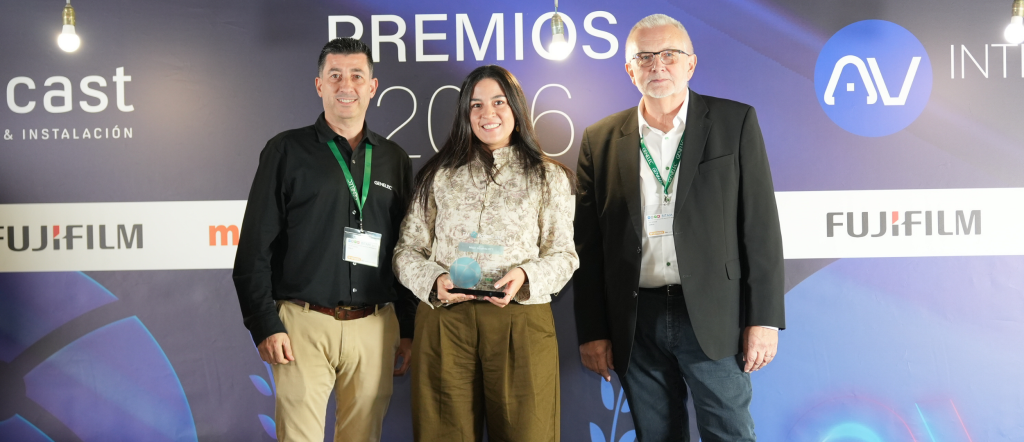
Filmin’s Recommender wins Best OTT Project at the TM Broadcast Awards
- The tool is based on an “algotorial” approach, in which the algorithm always works on top of a prior layer of human editorial judgement. It is an expression of Filmin’s digital humanism, which puts technology at the service of people’s judgement and not the other way round.
Last Thursday, 29 October, Filmin collected the award for Best OTT Project at the TM Broadcast Awards 2026 for its Interactive Recommender, a tool that helps viewers decide what to watch. The ceremony was held at the Madrid Arena as part of BITAM Show 2026. Each year, these awards set out to offer a snapshot of the audiovisual industry’s technological evolution, recognising projects for their reach, innovation and execution.
The jury particularly praised the tool’s personalisation capabilities, its mood-based recommendations and the sophistication of its content discovery mechanisms. “As an OTT, Filmin brings features that nobody else had until now”, one of its members summed up.
The award has a special meaning for Filmin. The platform is often recognised for its catalogue and for its films and series. This time the award is for its technology, developed entirely in-house by a multidisciplinary team from IT, product, design and editorial.
How Filmin’s Interactive Recommender works
The Interactive Recommender offers two modes. “Ask me”, asks a sequence of questions about four aspects: the user’s mood, the time they have available, their energy level and the period of production. “Surprise me”, on the other hand, generates an instant recommendation without any questions, based on the user’s history and general catalogue signals.
The Recommender’s architecture is hybrid and combines filters, weightings and behavioural signals, always on an editorial foundation. Mood is translated into thematic tags such as light-hearted films, intense titles, thoughtful stories or entertainment films. The period of production works as an exclusionary filter. Running time and narrative density are flexible filters that are relaxed when very few results come back. On top of all this come user signals, such as recent viewing, the titles they have saved in their personal lists or their affinity with particular editorial collections.
The final layer is the “user editorial score”, a multiplier that combines users’ average rating of each title with Filmin’s editorial judgement, to balance popularity, personal affinity and cinematic quality. This is where the algotorial approach can be seen in practice. The human team does not simply supervise what the machine does: it designs the framework and thinks about how the algorithm can optimise it. It is a recommendation model that does not depend on an opaque algorithm, but on a formula that brings together data and curation.
The first version of the Recommender was launched on Smart TV, where most Filmin viewing takes place. It was also the most demanding environment, as users navigate with a remote control and want a relaxed experience, so the team kept the number of steps needed to reach a recommendation to a minimum. The feature was later rolled out to the website and mobile apps. The development also includes a measurement system that records every interaction, so that the tool can fine-tune the quality of its recommendations based on real usage data.
The project shows that improving an OTT platform’s recommendation capabilities does not always require complex artificial intelligence systems. What Filmin proposes is to combine technology, experience design and editorial knowledge of the content to emulate the experience of human recommendation.